
fortune24d ago
Tokenmaxxing is over. That’s because it never measured what really counts to see ROI from AI
Token usage is a poor proxy for firm-wide productivity gains. Those only come with workflow redesign.
#COMMODITIES
Token usage is a poor proxy for firm-wide productivity gains. Those only come with workflow redesign.
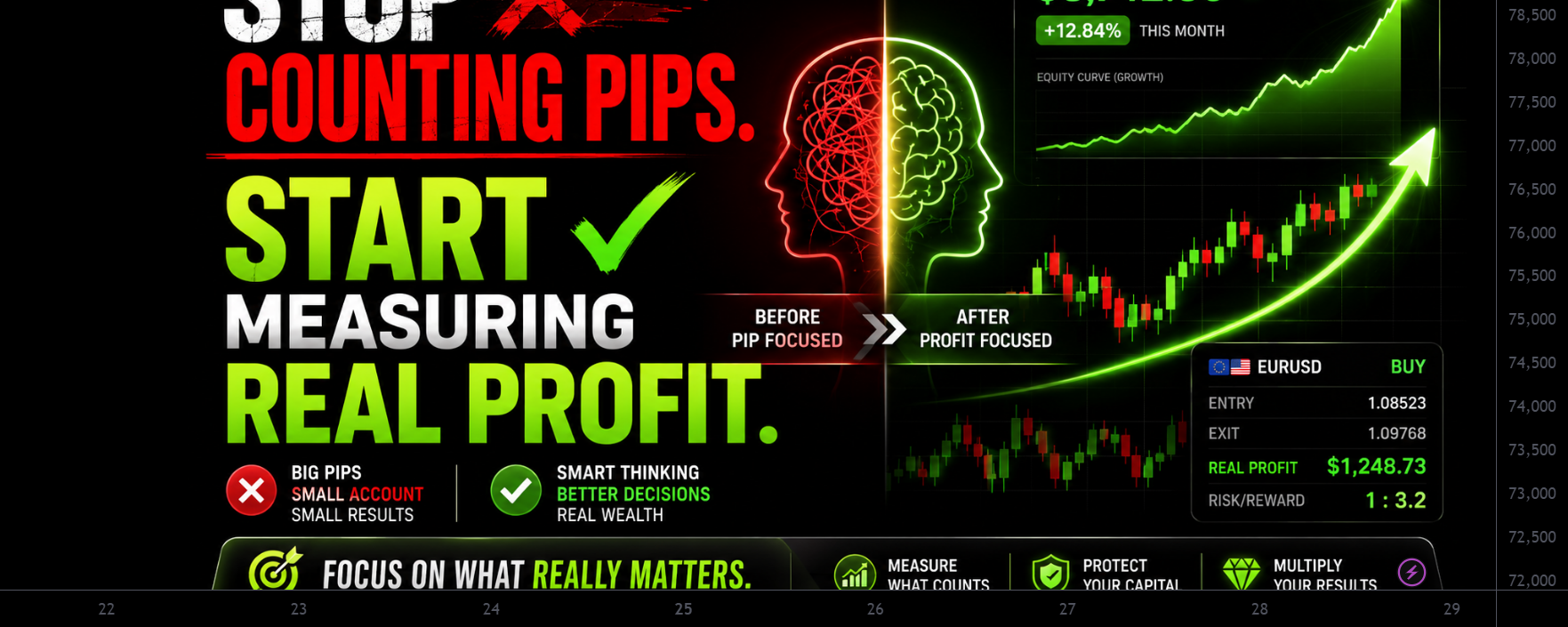
Stop Measuring Your Trading Performance in Percentages or Pips Most traders track their performance the wrong way. They obsess over pip counts, celebrate percentage returns, and compare account balances. None of that tells you whether you are actually trading well. Today I want to show you a better way to measure your results, one that professional traders and prop firms actually use. This article is written for shorter-term traders who typically hold one to three positions at a time. If you manage a diversified stock portfolio or a hedge fund with dozens of assets, this may not apply directly to you. But if you are a retail trader managing your own account, read this carefully because it will change how you look at your performance. Why Percentages and Pips Are Misleading Here is the problem with measuring returns in percentages. A 100% return on a $500 account means you made $500. A 20% return on a $50,000 account means you made $10,000. Which trader performed better? The percentage says the first one. The reality says the second one. Percentages look impressive on paper but they do not reflect the actual skill or risk involved in making those returns. Pips have the same problem. A trader risking 50 pips to make 20 pips is performing very differently from a trader risking 10 pips to make 30 pips, even if both made the same number of pips in total. The pip count alone tells you nothing meaningful. Every trader has a different account size, a different risk tolerance, and a different position sizing approach. Comparing performance using percentages or pips between two different traders is like comparing apples to oranges. It does not work. The Right Way to Measure Performance: R The most accurate and useful way to track your trading performance is through something called R, which stands for your risk to reward ratio across all your trades. R is simply your total profits divided by your total losses over a series of trades. If you made $100,000 in a year but lost $50,000, your R value is 2. That means for every dollar you lost, you made two dollars back. A 3R track record means you made three dollars for every dollar lost. This number is what actually matters. It tells you whether your strategy is working, whether your risk management is sound, and whether you are making more than you are losing in a way that is sustainable over time. Here is a real example using 20 trades with fixed risk: https://www.tradingview.com/x/YJcNhfXB/ Trade 01: +3R (Winner) Trade 02: -1R (Loser) Trade 03: -1R (Loser) Trade 04: -1R (Loser) Trade 05: +3R (Winner) Trade 06: +3R (Winner) Trade 07: -1R (Loser) Trade 08: -1R (Loser) Trade 09: +5R (Winner) Trade 10: +4R (Winner) Trade 11: +2R (Winner) Trade 12: -1R (Loser) Trade 13: -1R (Loser) Trade 14: -1R (Loser) Trade 15: +3R (Winner) Trade 16: +6R (Winner) Trade 17: -1R (Loser) Trade 18: -1R (Loser) Trade 19: -1R (Loser) Trade 20: +4R (Winner) Total Wins: 33R Total Losses: 11R Overall R: 3R (33 divided by 11 = 3) Notice something important in that example. Out of 20 trades, 11 were losers and only 9 were winners. That means this trader lost on 55% of their trades and still came out with a 3R overall result. This is exactly why win rate alone means nothing. What matters is how much you make when you are right compared to how much you lose when you are wrong. Account Size Does Not Tell the Full Story Here is something most traders do not think about. Due to leverage, a trader with $1,000 in their account can trade a similar position size to a trader with $20,000 in their account. Account balance is not a reliable indicator of how much risk someone is taking or how skilled they are. You do not need a large account balance to trade meaningful size. You need a clear understanding of your risk per trade. For this reason, keeping all your trading capital in one account makes very little sense. Most of it can sit in a separate savings or investment account earning interest while you only keep what you need to trade your desired position size. The account balance your broker sees is not a reflection of your overall financial position or your trading ability. Risk Tolerance Is Personal One trader might be comfortable risking $200 per trade. Another might risk $2,000. Neither is right or wrong as long as it fits within their personal financial situation and does not affect their ability to make clear decisions. A simple rule to check if you are risking too much: if your open trades are keeping you awake at night, your position size is too large. Risk tolerance grows naturally as your skills and track record develop. A beginner should start small and build confidence over time. An experienced trader with a proven edge can reasonably increase their risk per trade as their results justify it. But that confidence has to be earned through a track record, not assumed. What Prop Firms Actually Look At If you ever want to trade someone else's capital or attract outside funding, understanding R becomes even more critical. Prop trading firms do not care about your pip count or your percentage return in isolation. They look at your return relative to the risk you took to achieve it. A prop trader only gets paid when their R value is above 1. Anything below 1 means they lost more than they made, regardless of how many pips they caught. Banks, hedge funds, and prop firms all measure performance this way. They want to see that you are generating returns efficiently relative to the risk you are accepting. A long track record showing a consistent R value of 2 or 3 is far more impressive to a serious investor than a flashy percentage return achieved by risking too much on one trade. One Important Warning Understanding R does not mean you should start risking more per trade. That would completely miss the point. R is a measurement tool, not a license to increase your position size recklessly. The goal is to keep your risk fixed and consistent so that your R value accurately reflects your trading edge over time. If your risk changes from trade to trade, your R number becomes meaningless because you cannot compare the results fairly. Fix your risk, track your R, and let the results show you whether your strategy is actually working. Final Thought Stop chasing pip counts. Stop getting excited about percentage returns that look good on paper but mean very little in reality. Start measuring what actually matters, how much you make relative to how much you risk, consistently, over a large series of trades. A trader with a 3R track record over 100 trades has proven something real. A trader with a 200% return on a $300 account has proven very little. Track your R. Build your edge. Let the results speak for themselves. Thank you for reading. I hope this article helped you better understand market behavior, trading psychology, and risk management during volatile conditions. For more trading education, chart analysis, and market insights, follow: @Trade-Technique on @TradingView

FalconX has hired Cantor and other bankers to advise on a potential IPO and confidentially filed draft paperwork with the SEC, though the listing is not expected until later this year amid volatile market conditions.

Lock in today’s painful prices—or bet that volatility breaks your way? CFOs are being forced to choose. The post The New Hedging Dilemma appeared first on Global Finance Magazine .

The team at Bell Potter believes the stock can rise more than 20%. The post Why this ASX real estate stock is a compelling buy according to Bell Potter appeared first on The Motley Fool Australia .

Strong industry demand and ambitious expansion plans could help these Canadian stocks deliver solid long-term returns. The post 2 Canadian Stocks to Buy and Hold for the Next 5 Years appeared first on The Motley Fool Canada .

Governments globally are developing and launching digital identity schemes. A variety of models exist, and many of the largest are activated in the global south. India’s Aadhaar, the world’s largest biometric digital ID system , uses a centralized architecture, in which everything runs through the Unique Identification Authority of India (UIDAI). In a federated architecture, multiple credential issuers can issue credentials that are mutually recognized across sectors through conformance to a common framework, without the need for centralized databases. Then there is decentralized identity, which allows credentials to be issued once, stored by the user in a secure digital wallet, and reused across systems – theoretically giving users full control over their data through technologies like verifiable credentials, digital ID wallets and distributed ledger or blockchain technology. No central authority manages a user’s identity, and privacy-preserving tools like selective disclosure are built into wallet systems. MOSIP, the Modular Open-Source Identity Platform, aims to support these systems globally, and now has MOUs with 29 countries for rollouts and pilot programs, including the Philippines, Sri Lanka and Togo . But, even as these distinctions provide a framework for understanding different models for digital ID, there are still questions about what, exactly, decentralization means in national ID, depending on the context. Africa set to lead in on digital ID globally In a recent appearance on the Biometric Update Podcast , Claire Ma, founder of Sign , says as governments look to transform their digital infrastructure, including identity, they are all starting from a different perspective – and often need help managing the transition. “Different countries don’t start from a blank page,” she says. If, for example, India wanted to move Aadhar to a decentralized model, “there has to be a hybrid model in between, where they take it step by step.” Ma has suggested that Africa could emerge as a leader in digital ID globally, fueled by models like MOSIP, which was spun off from Aadhaar, and now underpins national digital ID systems in Ethiopia, Uganda, Sierra Leone and elsewhere. Morocco was the first country to implement MOSIP, and is now cited among the platform’s major success stories. (See Biometric Update’s new Understanding MOSIP report for detailed case studies.) In Ghana, says Ma, the Ghana Card (which is not MOSIP-aligned) has reached about 20 million people – somewhere around 90 percent of the population. “I definitely see a harder push from these African countries on digital ID initiatives,” she says. ID4Africa 2026 underscores importance of trust Takeaways from the recent ID4Africa 2026 AGM support the theory. Liberia is about to resume national ID card issuance, as it works on digital ID. Speaking with Biometric Update on location in Abidjan, Dr. Joseph Atick suggests that African ID authorities are leading thought in the national digital ID space globally, as evidenced by dramatic improvements in registrations, and in practical use cases. The market appears to be on the verge of a boom, and many voices at the event advocated for decentralized digital identity as the way forward in building the infrastructure of trust. As per usual, trust is the supporting beam of the conversation. The challenge is, that, too, means different things in different places. Claire Ma notes that, while the Indian government may be able to pre-load the Aadhaar app onto devices by default, that would never fly in a place like the U.S., where digital ID is still often perceived as a surveillance threat. Various governments will be comfortable with different levels of action in pushing digital ID on their citizens. The common factors across the spectrum are those on which trust depends. Regardless of what a decentralized digital ID scheme looks like, it needs strong governance frameworks, clear architecture, transparency, and the option to choose not to use it. “I think voluntary enrolment is really important,” says Ma. “Citizens need to feel like they are adopted into the system, not like they’re forced to accept it.” In comments made at the ID4Africa 2026 AGM, Ramamohan Reddy, CEO of Digital Trust Technologies, expresses similar sentiments. “While ID and identity verification are key enabling aspects of trust, they are only necessary conditions, not sufficient ones.” “Primarily, if citizens are to feel happy, empowered, and benefited, what do they want? They want safe, secure service delivery, and they want predictable service delivery by the government.” The lesson emerging from Africa, MOSIP and the broader digital identity ecosystem is that technology alone does not determine success. Trust, governance and local context shape how identity systems are designed, adopted and used. While common platforms may provide shared building blocks, the path to digital identity will remain different for every country.

Short sellers are piling into a wide-ranging group of names, with the latest Benzinga Pro data showing elevated bearish positioning across 10 stocks spanning energy, crypto, AI and enterprise software. PATH stock is heavily shorted. See the chart and price action here. Venture Global (NYSE: VG ) sits at the extreme top of the list, while CleanSpark (NASDAQ: CLSK ), Lucid Group (NASDAQ: LCID ) and a handful of high-growth and thematic names round out the most crowded short trades heading into June. High-Short-Interest Standouts Below are the top 10 most heavily shorted stocks (market caps above $2 billion, average 14‐day volume above 5 million and free floats above 5 million) based on data from Benzinga Pro as of May 28, 2026: Ticker Company Name Short % of Float VG Venture Global, Inc. 86.10% CLSK CleanSpark, Inc. 45.84% LCID Lucid Group, Inc. 44.55% PCT PureCycle Technologies, Inc. 39.88% FLNC Fluence Energy, Inc. 38.19% SOUN SoundHound AI, Inc. 38.06% FIG Figma, Inc. 36.89% BTDR Bitdeer Technologies Group 36.28% SATS EchoStar Corp. 36.10% PATH UiPath, Inc. 35.14% Closer Look Venture Global’s 86.10% short interest is the defining data point of this screen — nearly double the next name on the ... Full story available on Benzinga.com

Mumbai (Maharashtra) [India], May 28 (ANI): The Reserve Bank of India's (RBI) record dividend payout of Rs 2.87 lakh crore is expected to directly repair the government's balance sheet at a time when rising global energy prices and prolonged geopolitical tensions are putting pressure on India's fiscal position, according to Anindya Banerjee, Head of Commodities and Currency Research at Kotak Securities. Speaking

The threat of relegation hangs over the Australian men's rugby sevens squad ahead of the final two rounds of the World Championship series.

Eli Lilly and Company, Novo Nordisk A/S, and AbbVie are the three Pharmaceutical stocks to watch today, according to MarketBeat’s stock screener tool. “Pharmaceutical stocks” are shares of companies that develop, manufacture, market, and sell prescription drugs, over-the-counter medicines, and related healthcare products. For stock market investors, these stocks offer exposure to the healthcare sector [...]
Eli Lilly and Company, Boston Scientific, Thermo Fisher Scientific, UnitedHealth Group, and Johnson & Johnson are the five Medical stocks to watch today, according to MarketBeat’s stock screener tool. “Medical stocks” are shares of publicly traded companies in the healthcare and medical industry, such as drug makers, biotechnology firms, medical device manufacturers, hospitals, and healthcare [...]