organiser118d ago
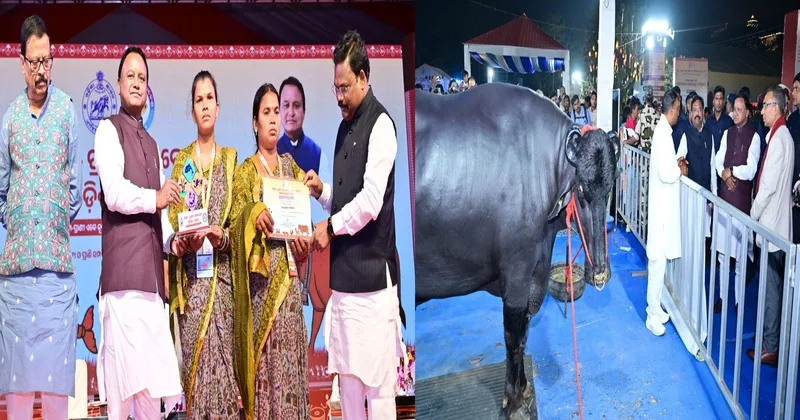
BHUBANESWAR: The Odisha government’s flagship Chief Minister Kamadhenu Scheme, launched with the objective of strengthening the dairy sector, has delivered encouraging results, leading to an additional 1.35 lakh litres of milk production within one and a half years, Chief Minister Mohan Charan Majhi announced on January 22. The Chief Minister was speaking at the inauguration of the three-day “Matsya-Prani Samavesh, Odisha–2026” held at Janata Maidan, Bhubaneswar, a major state-level event aimed at promoting fisheries and animal husbandry as key drivers of rural income and economic growth. Describing the Kamadhenu Scheme as a historic initiative, Majhi said the programme was introduced in the very first budget of the present government with a clear vision to boost milk production, enhance farmers’ income, and create a sustainable dairy ecosystem in the state. The scheme, implemented at an estimated cost of ₹1,400 crore, has already started yielding tangible outcomes, he said. “The increase of 1.35 lakh litres of milk production in just 18 months reflects the success of this initiative. The government remains fully committed to further enhancing dairy output and strengthening the rural economy,” the Chief Minister stated. Strong Financial Support for Dairy Farmers Under the Kamadhenu Scheme, farmers are being encouraged to rear high-yielding cross-bred cows and buffaloes, with the government providing financial assistance of up to 70 per cent of the cost. The Chief Minister informed that Rs 262 crore has already been disbursed to 4.73 lakh beneficiaries across the state, significantly expanding access to quality livestock and modern dairy practices. In addition, the Odisha State Cooperative Milk Producers’ Federation (OMFED) is extending an additional incentive of Rs 2 per litre to milk producers. This support has benefited more than 2.30 lakh cattle rearers, further strengthening the dairy value chain and ensuring better returns for farmers. Warning Against Cattle Smuggling During his address, Chief Minister Majhi issued a strong warning against cattle smuggling, stating that strict action would be taken against those involved in illegal activities related to cow trafficking. “Go-mata must be protected. Anyone found indulging in cattle smuggling will face stringent legal consequences,” he asserted. Highlighting the structural challenges in agriculture, the Chief Minister noted that nearly 92 per cent of Odisha’s farmers are small and marginal, and that landholdings are expected to shrink further. In this context, he stressed the importance of diversification, urging farmers to adopt fisheries and animal husbandry alongside agriculture to ensure sustainable livelihoods. He said the government has rolled out multiple schemes to support this transition. Rise in Farmers’ Income Speaking on rural prosperity, Majhi said that the effective implementation of schemes such as Samruddha Krushak Yojana, PM-KISAN, CM-KISAN, and Subhadra Yojana has significantly enhanced farmers’ earnings. As a result, the annual income of a farmer’s family has crossed Rs 61,000, marking a substantial improvement in rural household economics. Focus on Fisheries and Livestock Self-Reliance The Chief Minister reiterated the state government’s goal of making Odisha self-reliant in fish, meat, egg, and poultry production. He noted that Odisha currently ranks fourth in the country in fish production and is striving to secure the top position. To achieve this, the government is actively implementing schemes such as the Mukhyamantri Matsyajibi Kalyan Yojana, Mukhyamantri Krushi Udyog Yojana, Pradhan Mantri Matsya Sampada Yojana, and Pradhan Mantri Matsya Kisan Samriddhi Yojana. Modern practices like biofloc technology and cage culture are also being promoted to enhance productivity and sustainability in the fisheries sector. Distribution of Benefits and Awards At the event, Chief Minister Majhi distributed financial assistance to beneficiaries of the Kamadhenu Scheme and the Mukhyamantri Matsyajibi Kalyan Yojana. He also conferred the Gopal Ratna Award on Dilip Pradhan of Angul and the Native Breed Conservation Award on Sukant Kumar Biswal of Jajpur. Additionally, 12 outstanding farmers from the fisheries and animal husbandry sectors were felicitated for their exemplary contributions. Government to provide land for Goshalas Addressing the gathering, Revenue and Disaster Management Minister Suresh Pujari said that to protect cattle wealth and ensure the welfare of cows, gaushalas will be constructed wherever required across the state, with land to be provided by the Revenue Department. He noted that farmers are no longer limited to crop cultivation alone, as animal husbandry and fisheries have become integral parts of Odisha’s evolving agricultural system. He added that in the last 19 months, the highest number of cabinet proposals were related to fisheries and animal resources development, reflecting the government’s clear priority. Fisheries and Animal Resources Development Minister Gokulananda Mallik said the Kamadhenu Scheme has ushered in a new era of dairy revolution in Odisha. He highlighted that awareness programmes, fairs, and exhibitions have been organised across 314 blocks and 30 districts to educate farmers about opportunities in the fisheries and livestock sectors. From infrastructure development to direct farmer support, comprehensive measures have been put in place to accelerate growth in these areas. The event attracted a large number of fish farmers, livestock rearers, researchers, agricultural scientists, and students from across the state, underscoring Odisha’s growing focus on integrated and sustainable rural development.




![[UPDATED] Government mulls review of social media user threshold – Fahmi](/images/proxy?url=https%3A%2F%2Fassets.nst.com.my%2Fimages%2Flisting-featured%2F2716D463B3FB2534B2AD9E04F743735F_data_2.jpg)