recentlyheard135d ago
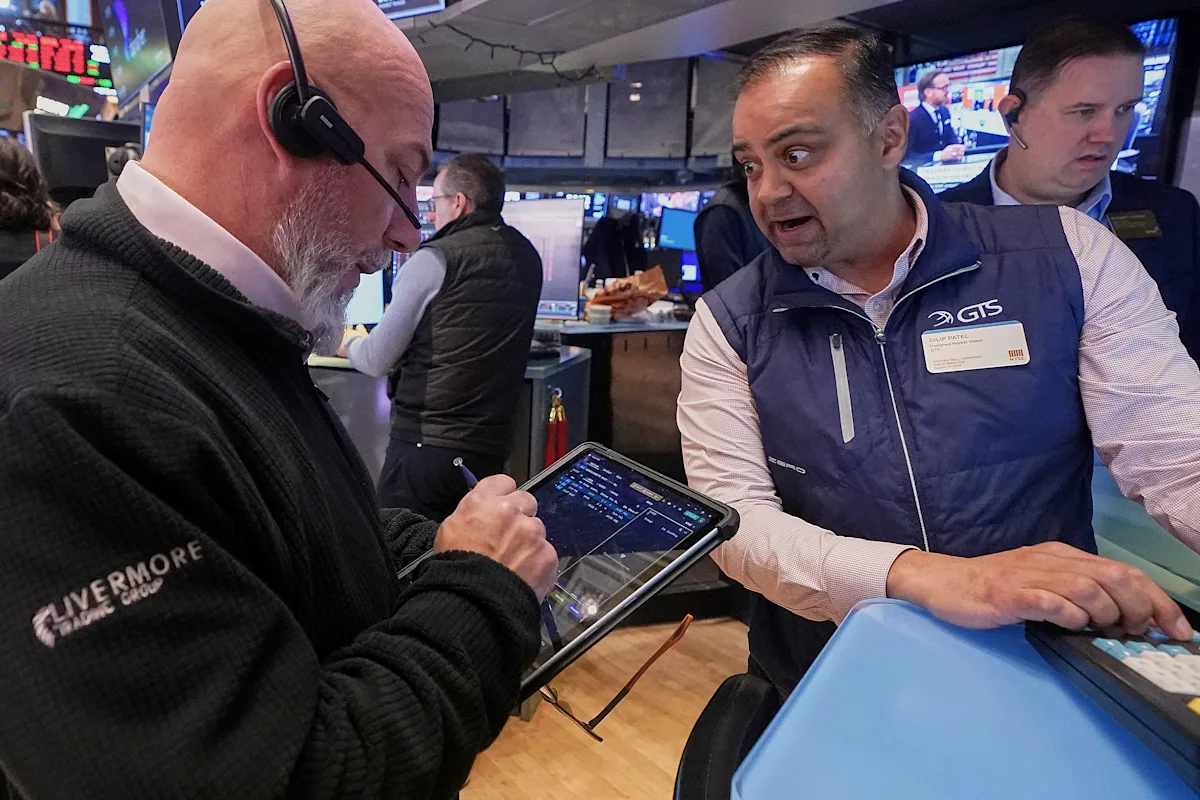
Dow crosses 50,000 mark, leading S&P 500, Nasdaq higher as Wall Street rebounds from rout
US stocks jumped on Friday, set to rebound from a weeklong tech bruising as Wall Street reassessed worries about the [...]
#CRYPTO
US stocks jumped on Friday, set to rebound from a weeklong tech bruising as Wall Street reassessed worries about the [...]

US stocks jumped Friday as tech shares recovered and bitcoin stabilized after recent losses.

MARA Holdings pivots from crypto mining to AI/HPC cloud, leveraging low-cost gas power and the Exaion acquisition. Click for my latest analysis of MARA stock.

New Gold Inc. (NYSE:NGD – Get Free Report) shares shot up 10.1% on Friday . The stock traded as high as $10.40 and last traded at $10.3780. 2,495,335 shares changed hands during trading, a decline of 89% from the average session volume of 22,051,588 shares. The stock had previously closed at $9.43. Wall Street Analyst [...]

Coeur Mining, Inc. (NYSE:CDE – Get Free Report)’s stock price shot up 10.1% during trading on Friday . The company traded as high as $21.08 and last traded at $21.0460. 3,472,614 shares were traded during mid-day trading, a decline of 88% from the average session volume of 28,133,318 shares. The stock had previously closed at [...]

As February 2026 brings fresh developments to the cryptocurrency space, with Bitcoin stabilizing around $70,000 after recent dips and the market cap approaching $2.5 trillion per CoinMarketCap data, attention turns to innovative projects in the best crypto presale 2026 category.

As market participants look ahead to 2026, attention is shifting toward best presale coins right now that combine AI use cases, fintech tools, and real-world demand. Several early-stage projects are gaining traction by solving specific problems across privacy, analytics, deal discovery, and payments. These include Zero Knowledge Proof (ZKP), DeepSnitch AI, IPO Genie, and Digitap, [...]The post Best Presale Coins Right Now That Could Deliver Huge Gains: ZKP Crypto, DeepSnitch AI, IPO Genie, & Digitap appeared first on Tekedia.
(MENAFN - EIN Presswire) EINPresswire/ -- Right Skale Inc. today announced the launch of DualEnroll, an AI-powered platform designed to automate Medicare and Medicaid dual enrollment and ...

If you want an all-around performer at a reasonable price, Lodge is the smartest choice. It’s a reliable, well-built enameled cast-iron Dutch oven that delivered consistent results across every test I performed.

Feb 6 : Goldman Sachs is working with technology startup Anthropic to develop AI-powered agents aimed at automating a widening range of internal functions, CNBC reported on Friday, citing the bank’s chief information officer.Goldman Sachs confirmed the accuracy of the report.The Wall Street bank has

(MENAFN - AsiaNet News) The deployment would be progressive, WeRide said, while adding that it would add more depending on regulatory clearances. The deployments are expected to be completed as ...

Crypto’s latest drawdown hit the majors in size: bitcoin fell about 8.1% over the past 24 hours and is down roughly 29.5% over the past 30 days, while Ether dropped about 9.4% on the day and about 41.4% over the past month; XRP was off about 10.3% in 24 hours and roughly 42.7% over 30 days, and Solana slid about 12.3% on the day and around 42.8% over the month. While many point to the nomination of Kevin Warsh as next US Federal Reserve chair, renowned macro analyst Alex Krüger argued on X on Friday that it is the cumulative effect of narrative fatigue, weakening marginal demand, and a macro regime wake-up call that hit after the market had already started to roll over. What Went Wrong For Crypto? Krüger framed the move as a momentum break that turned into a seller’s market. In his telling, the “10/10 slaughter” — a nod to the sharpness of the unwind, with a pointed aside about whether he’d “get sued” for mentioning Binance — was less a mystery than a pileup of factors that steadily drained risk appetite and then yanked away the last hope of a liquidity tailwind. Related Reading: Bitwise CIO Warns Market Is Facing A ‘Full-Bore’ Crypto Winter, Not A Pullback He pointed first to the hangover from Digital Asset Treasuries (DATs), and then to a reversal in flows tied to criminal networks. Krüger said “major flows reversed after the DoJ indictment of the Cambodian Prince Group last October,” describing it as a material shift in demand that the market may have been underappreciating while price was still holding up. What went wrong with crypto 1. 10/10 slaughter (will I get sued if I mention Binance?). 2. Digital Asset Treasuries (DATs) hangover. 3. Reversed flows from crime syndicates: major flows reversed after the DoJ indictment of the Cambodian Prince Group last October. 4. Quantum... — Alex Krüger (@krugermacro) February 6, 2026 Two other themes in his post leaned explicitly on fear and opportunity cost. Krüger flagged “quantum fears (real)” as a psychological overhang, and then argued that the AI boom has become a direct competitor for both capital and talent. He said the pivot isn’t subtle: “capital pivoting to AI,” “talent pivoting to AI,” and even “miners pivoting to AI,” all of which tighten the loop around crypto’s ability to reaccelerate. In parallel, he suggested the market’s global bid has narrowed. Krüger cited a “perception of Bitcoin as American,” adding that there are “few Chinese buyers,” a contrast with the participation he said had been “behind the metals uptrend in large numbers.” He also described a structural shift in who “owns” the trade. “The Swamp & Institutions taking over,” he wrote, arguing the market has moved from “Cypherpunk/Rebel tech to ETF tech.” In his framing, crypto used to be “for misfits & geniuses,” but now “it’s a line item in a 401k” — a change that, in his view, crowds out the volatility-driven momentum that historically pulled in OGs and retail. Other pressure points were more familiar: political risk around Trump association (“what happens once Democrats are back?”), “minimal innovation (since Hyperliquid),” and the brutal reflexivity of the Solana memecoin cycle — “Solana casino massacre (thank Pump Fun & the Memecoin Supercycle).” He paired that with a supply critique: “There are 29.91 million cryptocurrencies tracked by CoinMarketCap,” he wrote, warning that “almost every coin in the top 200 is grossly overvalued” alongside “never ending” launches that “pump then dump to oblivion where only insiders profit.” He even declared the “dead digital gold narrative” as another drag on marginal buyers. Related Reading: Crypto Isn’t Broken, It’s A US Liquidity Squeeze, Says Raoul Pal The mechanical result, Krüger said, was straightforward: “sellers dumping more aggressively than usual on every pump,” while “buyers not showing up to buy the dips as much any longer.” Then came what he framed as the macro trigger that hardened the selloff. “And then came the Warsh nomination (beating Hassett and Rieder), and the market suddenly became deeply aware that Warsh is a strong advocate of a small balance sheet: goodbye Quantitative Easing (QE) and Yield Curve Control (YCC) dreams, hello Quantitative Tightening (QT) fears. That is what happened.” Krüger stressed he was describing the past, not forecasting the next move, arguing the damage has already been done. Still, he noted that “volume, liquidations, implied volatility and options skew indicate that a local bottom is likely in.” In replies, the conversation turned toward what crypto might still be for in an AI-led cycle. A user said the rotation “makes sense,” but argued the bigger upside is in “agent stacks” that could eventually “manage crypto liquidity,” positioning crypto rails as infrastructure for machine-to-machine value transfer. Krüger largely agreed on the asymmetry. “I don’t know. I was hoping momentum. Momentum can do magic,” he wrote. “I’m very concerned about points #3 and #4. Saylor just started a new initiative on #4, maybe that helps. Reality is crypto can’t compete with AI. It’s impossible. But it could be used by AI. That’s high quality hopium right there. Agent-to-Agent payments would be better served on crypto rails.” At press time, BTC traded at $66,029. Featured image created with DALL.E, chart from TradingView.com