24-hour forex trading is coming. Who is winning: Korea or Wall Street?
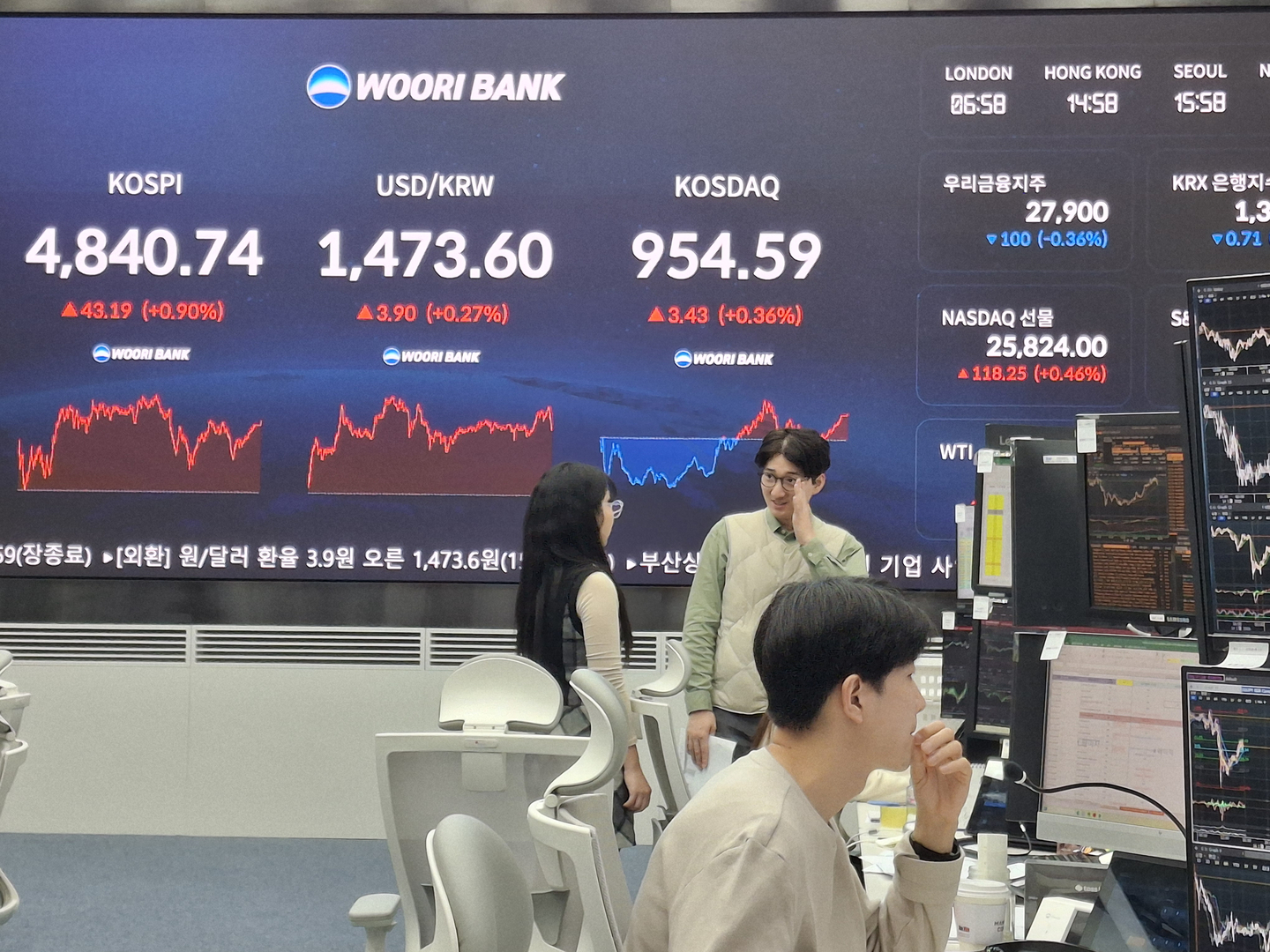
Electronic display boards at Woori Bank in central Seoul show Korea's market on Jan. 16. [WOORI BANK] [NEWS ANALYSIS] Korea’s push for around-the-clock currency trading could bring the country closer to developed-market status, but experts warn that the move is a double-edged sword that could trigger greater outflows of foreign capital as much as it raises expectations for inflows, heightening concerns over the won weakening further. These worries arose after retail investors bet a record amount on U.S. stocks due to the AI boom and expectations that the dollar will remain strong against the won. “The problem is that the government expects longer trading hours to stabilize the weak won by bringing larger inflows of dollars,” said Kim Sang-bong, an economics professor at Hansung University. “On the flip side, however, the exchange rate could worsen if larger amounts of funds flow out.” Related ArticleBOK signals an end to rate cut cycle as won shows sustained weaknessWith rate cuts derailed by won, Korea must move faster on structural reform (KOR)U.S. treasury secretary's rare public remarks help lift won in first daily gain this year Earlier this month, the Ministry of Economy and Finance announced that the closing time for foreign exchange trading hours will be extended from the current 2 a.m. to 24 hours on weekdays by July, with the goal of entering Morgan Stanley Capital International’s (MSCI) developed-market classification. A pilot offshore won settlement system, which enables foreigners to transact with one another through intermediaries while the Bank of Korea handles settlements, is also set to launch by September. The measures were announced five months ahead of MSCI’s scheduled annual classification review in June, as well as at a time when financial authorities have been striving — albeit unsuccessfully — to rein in the weak won through a series of policy measures. The won is hovering at a 16-year low as it approaches 1,480 against the greenback, though it briefly traded below 1,450 won at the end of last year following the government's reform measures on currency trading. Convenient but little market change While reforms represent a meaningful structural step toward a fully open currency market, analysts say they are unlikely to fundamentally reshape the overall trading volume. “The overall trading structure isn’t expected to change, at least in terms of volume,” said Min Kyung-won, an analyst at Woori Bank. “The won can already be traded in the nondeliverable forward [NDF] market — typically via one-month dollar-won contracts — even after the onshore market has closed. Extending trading hours would thus mainly shift where transactions take place instead of meaningfully increasing overall trading activity by creating demand that did not previously exist.” An NDF is a financial derivative that allows investors to hedge or speculate on currencies with low liquidity. Unlike standard forward contracts, NDFs involve cash settlements rather than the physical exchange of currencies. They typically carry higher costs than conventional forward hedging. “Unless the stock market runs for 24 hours, most foreign capital investors will meet their currency exchange needs during regular trading hours,” Min added. Since the government extended currency trading hours to 2 a.m. in July 2024, average daily trading volume in Korea’s foreign exchange market has increased by 16.3 percent in the first year, according to government data. However, trading during the extended hours from 3:30 p.m. to 2 a.m. accounted for just 18 percent of total daily volume, despite this period comprising nearly two-thirds of the market’s total operating hours. Travelers convert currencies at Incheon International Airport on Dec. 24, 2025. [JOONGANG ILBO] Some have also raised doubts about the system's sustainability. “Korea’s around-the-clock trading will make the won systematically available at all hours, but its sustainability is questionable as domestic dealers would need to be positioned around the clock to make it work,” said Kim Han-soo, a senior researcher at the Korea Capital Market Institute (KCMI). Korea’s system differs from the offshore model, in which trading is distributed across global financial centers, not concentrated domestically. “Korea has avoided adopting such a system because monitoring would become difficult if the currency were traded abroad,” Kim added. The concern dates back to the 1997 Asian financial crisis, when a sudden rush for dollars strained the financial system. “Yet many experts now believe the foreign exchange market has grown too large to monitor and control effectively.” Eyeing long-term gains Despite the limited immediate benefits, Korea is clearly moving in the right direction toward joining countries classified as having developed markets by the MSCI — a step essential for improving its market in the long term. “I don’t expect there to be an immediate impact in the foreign exchange and Kospi market with this news,” said EJ Ethan Seo, the head of global markets at BNP Paribas Korea. “An infrastructure upgrade usually doesn’t immediately affect the industry and market, but it definitely contributes to longer-term market structure, volume, depth and confidence, not only in the equity market but also for Korean products overall.” Extending currency trading hours could also help stabilize the foreign exchange market to some extent by making it easier for domestic investors to carry out foreign investments. “Longer trading hours would make it easier for domestic investors buying foreign stocks to convert currency promptly and respond to price movements in real time,” Min from Woori Bank added. “This would reduce the concentration of currency conversion demand at the market opening at 9 a.m., when transactions are heavily clustered, and thereby help prevent sharp fluctuations in the currency exchange rate,” said Prof. Kim from Hansung University. [GETTYIMAGESBANK] Korea’s effort to secure a status upgrade dates back to at least 2008, when it was added to the watch list for the MSCI Developed Markets Index. However, Korea was dropped from the list in 2014 due to insufficient market accessibility, leaving it an emerging market. If the latest measures prove effective, Korea could be placed on MSCI’s watch list in the annual market classification review to be announced in June of this year, with a decision on its inclusion in the Developed Markets Index potentially made in June of next year. In this case, index-tracking funds are expected to begin flowing into the domestic market around 2028, when the actual inclusion takes effect and well before President Lee Jae Myung’s term ends in 2030. Seoul’s inclusion in MSCI’s developed market is expected to attract a net foreign capital inflow ranging from $5 billion to $36 billion, according to a KCMI report, though it could vary in accordance with Korea’s weight in global market capitalization. “It’s like playing football in a nice stadium,” said Seo from BNP Paribas Korea. “Just because we play in a great stadium doesn’t mean we always win the game, but it does set up the right structure. So this change is seen as very optimistic.” BY JIN MIN-JI [jin.minji@joongang.co.kr]