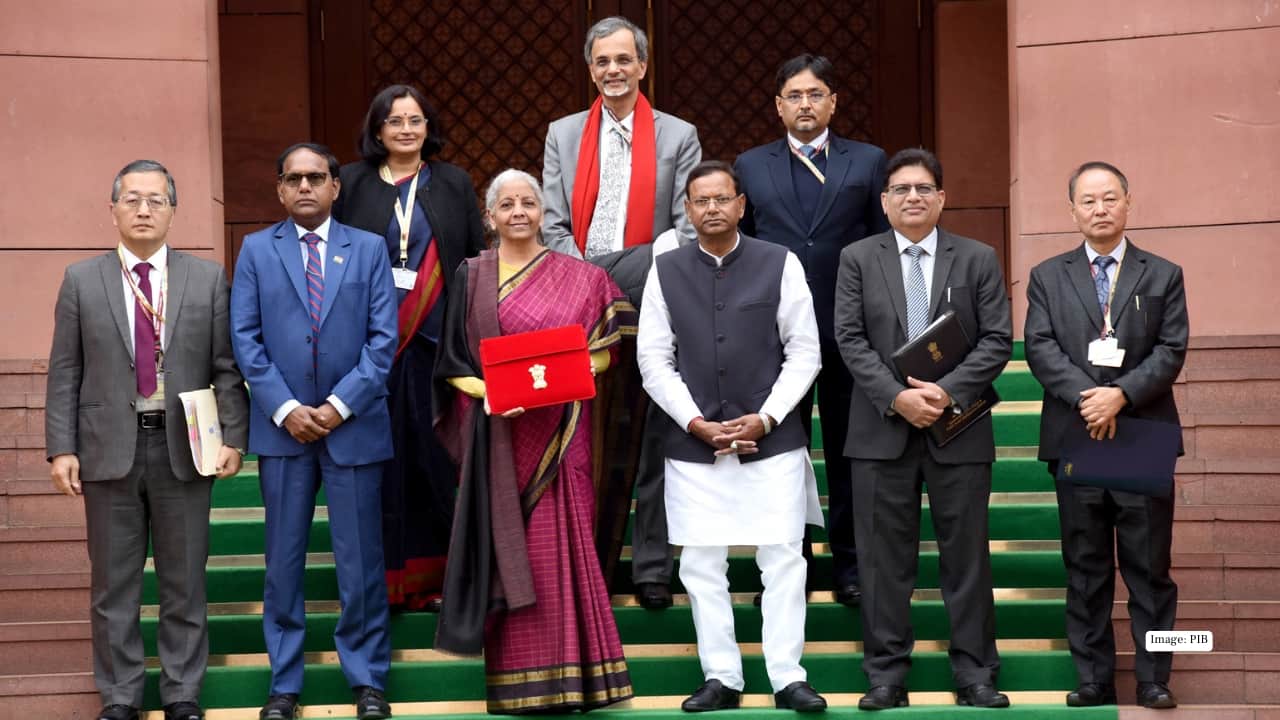
FY27 Budget: Capex, manufacturing, tax incentives take centre stage; markets wobble on STT hike
Finance Minister Nirmala Sitharaman on Sunday announced measures to boost manufacturing offered long-term tax incentives for global data centres and support for agriculture and tourism as she unveiled a Rs 535 lakh crore Union Budget for 2026-27 seen as a long-term blueprint for sustaining growth amid rising global risks Shunning populist measures despite five key states including West Bengal and Tamil Nadu heading to polls the Budget signalled continued fiscal consolidation and infrastructure spending But a hike in securities transaction tax on equity derivatives rattled equity markets with key indices plunging as much as 2 per cent in the special budget-day trading session before recovering some ground Presenting her record ninth consecutive Budget Sitharaman in her nearly 90-minute speech in the Lok Sabha announced detailed anchor schemes for becoming Viksit Bharat - boosting employment while combining technologies of the future with legacy industries Maintaining emphasis on infrastructure development capital expenditure has been raised to Rs 122 lakh crore next year from an already record-high Rs 112 lakh crore in FY26 Among the many infrastructure projects announced by the minister was a plan to build 7 high-speed rail corridors while defence expenditure is up by about a fifth on the year Amid geopolitical concerns fragmentation and financial tightening across the globe she said manufacturing will be scaled up across seven priority sectors - pharmaceuticals semiconductors rare-earth magnets chemicals capital goods textiles and sports goods - with an emphasis on job creation and technology-driven development The success of Apple iPhone manufacturing prompted doubling of outlay on electronics manufacturing to Rs 40000 crore and a second iteration of the semiconductor mission was mentioned to help build the supply chain While there were no major changes to personal income-tax slabs the government announced tax and incentive measures aimed at boosting investment and ease of compliance for the industry Sitharaman announced a Rs 10000 crore investment over five years to develop India as a biopharma manufacturing hub rare earth corridors textile parks more container manufacturing chemical parks measures to strengthen capital goods manufacturing and efforts to revive 200 legacy industrial clusters among others to boost industry A major announcement was a 20-year tax holiday for overseas firms providing global data centre services from India along with a 15 per cent safe harbour on costs for data centre services provided by related entities of foreign cloud firms The move is expected to provide tax certainty and operational efficiency for global cloud players as India attracts large-scale investments from firms such as Google Microsoft and Amazon Web Services which have committed about USD 40 billion in 2025 alone The Budget also simplified the customs regime rationalising exemptions waiving duties on 17 cancer drugs easing baggage rules and cutting duty on personal imports to 10 per cent Support was announced for livestock fisheries high-value agriculture and textiles while tourism proposals included eco-friendly mountain trails in Himachal Pradesh Uttarakhand and Jammu and Kashmir and the development of 15 archaeological sites To support small businesses the government proposed a Rs 10000 crore SME Growth Fund to help scale future champions On the fiscal front the government reiterated its consolidation path targeting a reduction in the debt-to-GDP ratio to 556 per cent next year from 561 per cent and the fiscal deficit to 43 per cent from 44 per cent It plans to borrow Rs 172 lakh crore from bond markets where yields have firmed amid heavy supply Tax measures included a hike in securities transaction tax on futures trading to 005 per cent from 002 per cent and to 015 per cent from 001 per cent on options taxing share buybacks as capital gains cuts in TCS on overseas tours education and medical expenses and implementation of the new Income Tax Act from April 1 Today we face an external environment in which trade and multilateralism are imperilled and access to resources and supply chains are disrupted New technologies are transforming production systems while sharply increasing demands on water energy and critical minerals she said in her Budget speech India she said will continue to take confident steps towards Viksit Bharat balancing ambition with inclusion As a growing economy with expanding trade and capital needs India must also remain deeply integrated with global markets exporting more and attracting stable long-term investment she noted At a press conference post-presentation of the Budget Sitharaman defended the STT increase saying this was done with a view to discouraging small investors from speculative trading in derivatives Prime Minister Narendra Modi described the Union Budget 2026-27 as historic saying it reflected the aspirations of 140 crore Indians and strengthened the reform journey and charted a clear roadmap for Viksit Bharat Modi also said the Budget was a highway of opportunities This Budget is the foundation for our journey towards a Viksit Bharat by 2047 This years Budget will give Indias reform express new energy and new momentum he said We want to become the worlds third-largest economy as soon as possible The Budget seeks to accelerate the shift to a simpler corporate tax regime through changes to Minimum Alternate Tax MAT provisions Companies opting for the new regime will now be allowed to set off accumulated MAT credit capped at 25 per cent of annual tax liability From April 1 2026 MAT will become a final tax with no credit available for set-off further incentivising migration to the new regime While the fine print shows disputed corporate and personal tax demands have risen to about Rs 15 lakh crore from around Rs 13 lakh crore the Budget does not propose steps to curb the buildup Some relief has been offered through a cut in the pre-deposit requirement for tax appeals to 10 per cent from 20 per cent of the core tax demand Other key announcements include raising the investment limit for Persons of Indian Origin PROI in Indian listed companies from 5 per cent to 10 per cent with the aggregate limit increased to 24 per cent from 10 per cent To support energy transition a rare earth corridor is proposed to be established in Odisha Andhra Pradesh Kerala and Tamil Nadu alongside customs-duty exemptions for capital goods used in critical mineral processing The Rs 20000-crore CCUS programme provides a credible pathway to decarbonise power steel and cement while extending customs-duty exemptions for nuclear projects till 2035 strengthening long-term base-load stability On the tax front exemptions for battery energy storage systems lithium-ion cells solar-glass inputs and biogas-blended CNG materially improve project viability Acknowledgement of sports goods an underinvested sunrise sector marks a turning point for MSMEs and companies in the sector to find access to large global markets Boost to agriculture segments such as dairy poultry fisheries and MSMEs have been well aimed to drive inclusive development While the expectations were for big bang customs reforms the Budget focused on promoting domestic manufacturing in certain sectors like renewable energy aviation and electronic goods by reducing customs duties on components and capital goods One-time relief for SEZ units supplying goods to domestic tariff areas may help in somehow neutralising US Tariffs The allocation of Rs 785 lakh crore to defence with capital modernisation crossing Rs 2 lakh crore for the first time Commenting on the Budget Christian de Guzman Senior Vice President Moodys Ratings said in addition to the continued spending on infrastructure the Budget provides tactical support for the economy against the backdrop of prevailing external uncertainties including the unresolved issues around US tariffs and despite the proven resilience of economic growth over the past year At the same time support for the economy which includes measures announced in recent months such as GST rationalisation will lead to an ongoing erosion of tax revenue as a share of GDP that will worsen debt affordability as measured by interest payments relative to revenue Moreover we do not expect significant progress on debt reduction which supplants deficit consolidation as the anchor for fiscal policy leaving our broader assessment of Indias fiscal strength intact