fxstreet73d ago
Mexico Headline Inflation below forecasts (0.88%) in March: Actual (0.86%)
Mexico Headline Inflation below forecasts (0.88%) in March: Actual (0.86%)
#COMMODITIES
Mexico Headline Inflation below forecasts (0.88%) in March: Actual (0.86%)

VAL-D'OR, Quebec, April 09, 2026 (GLOBE NEWSWIRE) -- Cartier Resources Inc. (′′ Cartier ′′ or the ′′ Company ′′) (TSXV: ECR , FSE: 6CA)) is pleased to announce the appointment of Mr. Glenn Mullan to its Board of Directors. Mr. Mullan brings to Cartier a rare combination of technical depth, capital markets knowledge, governance experience and proven leadership in the Canadian mining industry. His appointment comes at a key time for the Company, as Cartier continues to sharpen its strategic focus and advance the Cadillac Project with a view to unlocking the next phase of value creation. With over four decades of experience spanning mineral exploration, project advancement, corporate development and public company leadership, Mr. Mullan is expected to make an important contribution as Cartier continues to build momentum and strengthen its position in the Val-d'Or mining camp. His addition to the Board further enhances the Company's capacity to execute on its priorities and support the disciplined advancement of its assets. "As Cartier continues to advance on its strategic path, the appointment of Glenn Mullan represents a meaningful addition to our Board," said Daniel Massé, Chairman of the Board of Directors. "Glenn brings a highly complementary combination of geological, corporate and capital markets expertise, together with a strong track record of value creation in the mining sector. His insight and experience will ... Full story available on Benzinga.com

CHEYENNE, Wyo., April 9, 2026 /PRNewswire/ -- U.S. Gold Corp. (NASDAQ: USAU) (the "Company" or "U.S. Gold") today announces its participation in the inaugural Swiss Mining Institute Conference (the "Conference"), taking place in Panama City, Panama on April 15-16, 2026. U.S. Gold Corp....
VANCOUVER, Canada, April 09, 2026 (GLOBE NEWSWIRE) -- Sonoro Gold Corp. (TSXV: SGO | OTCQB: SMOFF | FRA: 23SP) (“Sonoro” or the “Company”) is pleased to announce that, through its wholly owned Mexican subsidiary, Minera Mar de Plata (“MMP”), it has acquired a 100% interest in the Diana mineral concession (the “Diana Concession”), located adjacent to the central-eastern boundary of the Company’s Cerro Caliche gold project in Sonora, Mexico.
Continued Focus on People, Products, Planet and Governance Continued Focus on People, Products, Planet and Governance
Visa Direct is now live in OwlTing's OwlPay, enabling U.S. debit cardholders to fund USDC transactions directly, no exchange account required.

TotalEnergies, a French energy company, has abandoned its plans to construct wind turbines off the coast of Bald Head Island.

Up to 90 percent of construction and renovation workers in Bulgaria are operating outside the legal framework, according to entrepreneur Lozan Lozanov, who raised concerns about the lack of regulation in construction and installation services, particularly in the interior renovation sector. Speaking to BNR-Radio Sofia, he described an environment where “everyone does what they want” due to the absence of clear industry rules and oversight. Lozanov, who is the organizer of “Master Forum 2025” and runs a podcast focused on changing professional attitudes in the sector, argued that the industry currently lacks both formal associations and any unified structure....

British banking giant Barclays sees the Bangko Sentral ng Pilipinas (BSP) holding key interest rates steady at this month’s policy meeting before possibly hiking in June, in a bid to support the already weak economic growth outlook even prior to the war in the Middle East. “With the ceasefire likely to raise hopes of a more enduring de-escalation at the BSP—which recently held an off-cycle meeting where policymakers seem to have not been able to agree on a rate hike—focus would likely shift toward the potential damage inflicted by the conflict on the domestic economy,” Asia-based Barclays economists Brian Tan, Bum Ki Son, Aastha Gudwani, and Amruta Ghare said in an April 8 report obtained by Manila Bulletin. “The Philippines—which shifted to a four-day workweek for the civil service to conserve fuel—would likely be a jurisdiction where policymakers would be concerned over a deepening of the economic challenges already present before the Middle East conflict broke out,” they added, referring to the post-pandemic-low gross domestic product (GDP) growth last year in the aftermath of the flood-control corruption scandal. “We thus no longer expect a 25-basis-point (bp) rate hike in April,” they said. Barclays noted that at the onset of the war, it projected two consecutive 25-bp interest rate hikes by the BSP’s Monetary Board (MB) during its policy meetings scheduled on April 23 and June 18. It was a reversal of its earlier expectations of two straight rate cuts before the war. As the conflict in the Middle East dragged on, Barclays had forecast that monetary policy tightening would be followed by easing through three 25-bp cuts next year. However, as Barclays remains “wary of more lasting supply constraints from damages to energy facilities” inflicted by the war, it now expects an April pause and a 25-bp hike in June, to be followed by only two rate cuts in 2027. “The risk is that a lasting de-escalation would quickly shift the central bank back to easing mode,” Barclays explained. “The two 25-bp rate cuts we had earlier forecast for this year, to a terminal rate of 3.75 percent, might still be delivered after all after a near-term pause,” it said. The policy rate currently stands at 4.25 percent. Across emerging Asian central banks, Barclays believes the majority would welcome the de-escalation of the Middle East war but remain cautious in case tensions reignite or the conflict leaves lasting impacts on energy supply, the global economy, and financial stability. “Despite the ceasefire, emerging Asia is unlikely to escape at least some lasting economic drags from persistent supply constraints—at the least, economic data in the next quarter or two could remain under pressure,” Barclays said. “We think the economic scarring from the attacks on energy facilities and ports in Iran as well as other Gulf nations could continue to keep supply under stress in emerging Asia,” it added.
Unlock your SME's potential with expert insights on scaling effectively. Explore strategic funding and growth opportunities essential for the vibrant future of South Africa's small business landscape.
MINNEAPOLIS, April 09, 2026 (GLOBE NEWSWIRE) -- Northern Technologies International Corporation (NASDAQ: NTIC ), a leading developer of corrosion inhibiting products and services, as well as bio-based and biodegradable polymer resin compounds, today reported its financial results for the second quarter of fiscal 2026. Second quarter fiscal 2026 financial and operating highlights include (with growth rates on a fiscal quarter year-over-year basis): Consolidated net sales increased 15.3% to a record second quarter of $21,997,000 ZERUST® industrial net sales increased 11.2% to $13,967,000 ZERUST® oil and gas net sales increased 72.1% to a second quarter record of $2,666,000 Natur-Tec® product net sales increased 8.1% to $5,363,000 NTIC China net sales increased 18.5% to $4,425,000 Gross profit, as a percentage of net sales, increased 10 basis points to 35.7% Joint venture operating income increased 19.8% to $2,027,000 Operating income improved to $383,000, compared to an operating loss of $(333,000) in the prior-year quarter Net loss attributable to NTIC was $35,000, compared to net income attributable to NTIC $434,000 Net loss per diluted share attributable to NTIC was $(0.00), compared to net income per diluted share attributable to NTIC of $0.04 For second quarter of fiscal 2025, NTIC recognized $1,140,000 in other income due to the receipt of an Employee Retention Credit (ERC) payment Non-GAAP adjusted net income (1) was $70,000, or $0.01 per diluted share, compared to a Non-GAAP adjusted net loss of $300,000, or $(0.03) per share for the same period last year "Our results were in line with our long-term growth strategy. Second quarter performance was driven by solid top-line growth across our businesses, including record second quarter ZERUST® oil and gas net sales, with year-over-year growth across all geographies, in accordance with the investments we have made in our global sales infrastructure and the increasing adoption of our VCI solutions within the global oil and gas industry. We have also seen consistent strength at NTIC China, despite the seasonal impact of the Lunar New Year and achieved another solid quarter of Natur-Tec® growth. Overall, second quarter and year-to-date results reflect the resilience of our business model and the increasing value customers place on our corrosion prevention and compostable plastics solutions," said G. Patrick Lynch, President and CEO of NTIC. "While the macro environment, including geopolitical tensions in the Middle East, ongoing supply chain pressures, and continued challenges in the European economy, has become more uncertain, we remain confident in the direction of our business and the strategies we are executing to drive long-term value. The diversity of our end markets, geographic footprint, and product portfolio positions us well to navigate near-term volatility. As we move through the second half of fiscal 2026, we expect continued sales growth and improved profitability, supported by stable trends in North America and ongoing strength in NTIC China, ZERUST® oil and gas, and Natur-Tec®," concluded Mr. Lynch. NTIC's consolidated net sales increased 15.3% to $21,997,000 during the three months ended February 28, 2026, compared to $19,072,000 for the three months ended February 28, 2025. The year-over-year increase in second quarter sales was primarily driven by increased sales and demand for ZERUST® and Natur-Tec® products. For the first half of fiscal 2026, consolidated net sales increased 12.1% to $45,306,000, compared to $40,410,000 for the same period last year. The following tables set forth NTIC's net sales by product category for the three and six months ended February 28, 2026, and 2025, by segment: Three Months Ended February 28, 2026 % of Net Sales 2025 % of Net Sales % Change ZERUST ® industrial net sales $ 13,967,414 63.5 % $ 12,562,853 65.9 % 11.2 % ZERUST ® oil & gas net sales 2,666,042 12.1 % 1,549,164 8.1 % 72.1 % Total ZERUST ® net sales $ 16,633,456 75.6 % $ 14,112,017 74.0 % 17.9 % Total Natur-Tec ® net sales 5,363,329 24.4 % 4,960,049 26.0 % 8.1 % Total net sales $ 21,996,785 100.0 % $ 19,072,066 100.0 % 15.3 % Six Months Ended February 28, 2026 % of Net Sales 2025 % of Net Sales % Change ZERUST ® industrial net sales $ 28,889,932 63.7 % $ 26,525,105 65.6 % 8.9 % ZERUST ® oil & gas net sales 5,059,720 11.2 % 3,062,715 7.6 % 65.2 % Total ZERUST ® net sales $ 33,949,652 74.9 % $ 29,587,820 73.2 % 14.7 % Total Natur-Tec ® net sales 11,356,014 25.1 % 10,822,639 26.8 % 4.9 % Total net sales $ 45,305,666 100.0 % $ 40,410,459 100.0 % 12.1 % Net sales at NTIC's joint ventures, which are not consolidated with NTIC's financial results, increased 18.6% to $23,484,000 during the three months ended February 28, 2026, compared to $19,800,000 for the three months ended February 28, 2025. NTIC's total income from joint venture operations increased 19.8% to $2,027,000 during the three months ended February 28, 2026, compared to $1,691,000 during the three months ended February 28, 2025. The $336,000 increase in total income from joint venture operations was primarily due to an increase in sales at NTIC's joint ventures. Year-to-date, NTIC's joint venture operating income was $4,318,000, compared to joint venture operating income of $4,105,000 during the six months ended February 28, 2025. Net sales of NTIC's joint ventures were $48,015,000 for the six months ended February 28, 2026, compared to $43,637,000 for the six months ended February 28, 2025. Operating expenses, as a percentage of net sales, for the second quarter of fiscal 2026 were 43.2%, compared to 46.2% for the same period last fiscal year. Year-to-date, operating expenses, as a percent of net sales, were 42.5%, compared to 45.3% for the same period last fiscal year. Operating expenses for the three and six months ended February 28, 2026 increased 7.7% and 5.2%, respectively. These increases were primarily due to strategic investments in ZERUST® oil and gas marketing and sales efforts. NTIC recognized $1,140,000 in other income during the three and six months ended February 28, 2025, due to the receipt of a cash ERC payment. No other income was recognized during the three and six months ended February 28, 2026. Net loss attributable to NTIC for the second quarter of fiscal 2026 was $35,000, or $(0.00) per diluted share, compared to net income attributable to NTIC of $434,000, or $0.04 per diluted share, for the same period last fiscal year. Year-to-date, net income attributable to NTIC was $202,000, or $0.02 per diluted share, compared to net income attributable to NTIC of $995,000, or $0.10 per diluted share, for the same period last fiscal year. NTIC's non-GAAP adjusted net income (1) , as set forth in the GAAP reconciliation at the end of this release, was $70,000, or $0.01 per diluted share, for the second quarter of fiscal 2026, compared to a net loss of $300,000, or $(0.03) per diluted share, for the same quarter last fiscal year. Year-to-date, non-GAAP adjusted net income was $414,000, or $0.04 per diluted share, compared to net income of $367,000, or $0.04 per diluted share, for the same period last fiscal year. NTIC had working capital of $20,202,000 as of February 28, 2026, including $6,470,000 in cash and cash equivalents and an outstanding revolving line of credit and term loan balance of $14,259,000, compared to $20,439,000 of working capital as of August 31, 2025, including $7,251,000 in cash and cash equivalents and an outstanding revolving line of credit and term loan balance of $12,189,000. At February 28, 2026, NTIC had $29,748,000 of investments in joint ventures, of which $15,400,000, or 51.8%, was cash, with the remaining balance mostly made up of other working capital. Conference Call and Webcast NTIC will host a conference call today at 8:00 a.m. Central Time to review its results of operations for the second quarter of fiscal year 2026 and its outlook, followed by a question-and-answer session. The conference call will be available to interested parties through a webcast. To join the live call and ask a question, a participant must register using the URL below. https://register-conf.media-server.com/register/BI189d44aede034eeaa9847116235afb6b Once registered, the participant will receive a dial-in number and unique PIN number to access the call. The audio-only webcast can be accessed at the following link: https://edge.media-server.com/mmc/p/3ffaprzx A link to the webcast is also available on the Investor Relations section of NTIC's webpage. Participants are advised to go to the website at least 15 minutes early to register, download and install any necessary audio software. For those unable to participate in the live webcast, a replay of the webcast will be archived and accessible for approximately one year on the Investor Relations section of NTIC's webpage. About Northern Technologies International Corporation Northern Technologies International Corporation develops and markets proprietary, environmentally beneficial products and services in over 65 countries either directly or via a network of subsidiaries, joint ventures, independent distributors and agents. NTIC's primary business is corrosion prevention marketed mainly under the ZERUST® brand. NTIC has been selling its proprietary ZERUST® rust and corrosion inhibiting products and services to the automotive, general industrial, mechanical, mining, agricultural, and retail consumer markets for over 50 years and, more recently, has also expanded into the oil and gas industry. NTIC offers worldwide on-site technical consulting for rust and corrosion prevention issues. NTIC's technical service consultants work directly with the end users of NTIC's products to analyze their specific needs and develop systems to meet their technical requirements. NTIC also markets and sells a portfolio of bio-based and biodegradable polymer resin compounds and finished products marketed under the Natur-Tec® brand. Forward-Looking Statements Statements contained in this release that are not historical information are forward-looking statements within the meaning of the Private Securities Litigation Reform Act of 1995. Such statements include NTIC's beliefs that the diversity of its end markets, geographic footprint, and product portfolio positions NTIC well to navigate near-term volatility and that as NTIC moves through the second half of fiscal 2026, it expects continued sales growth and improved profitability, supported by stable trends in North America and ongoing strength in NTIC China, ZERUST® oil and gas, and Natur-Tec®, and other statements that can be identified by words such as "believes," "continues," "expects," "anticipates," "intends," "potential," "outlook," "will," "may," "would," "should," "guidance" or words of similar meaning, and the use of future dates. Such forward-looking statements are based upon the current beliefs and expectations of NTIC's management and are inherently subject to risks and uncertainties that could cause actual results to differ materially from those projected or implied. Such potential risks and uncertainties include, but are not limited to, in no particular order: the effect of the U.S.-Israel-Iran conflict, which has had immediate and substantial effects on global trade, energy markets and financial markets; risks associated with international operations, including NTIC China, exposure to exchange rate fluctuations, tariffs, trade disputes and changes to trade regulation; the health of the U.S. and worldwide economies, including in particular the U.S. automotive industry, decreased exports of automotive products resulting from tariffs between the U.S. and both Mexico and Canada and the evolution towards electric vehicles; the effect of economic uncertainty, recessionary indicators, inflation, increased interest rates and turmoil in the global credit, financial and banking markets or perception thereof; effect of supply chain disruptions; dependence on joint ventures, relationships with joint venture partners and their success, including fees and dividend distributions; effect of economic slowdown and political unrest, including the war between Russia and Ukraine and the conflicts in the Middle East; the level of growth in NTIC's markets; NTIC's investments in research and development efforts; acceptance of existing and new products; timing of purchase orders under supply contracts; variability in sales to oil and gas customers and effect on quarterly financial results; increased competition; costs and effects of complying with changes in tax, fiscal, government and other regulatory policies, and rules relating to environmental, health and safety matters; and NTIC's reliance on its intellectual property rights and the absence of infringement of the intellectual property rights of others. More detailed information on these and additional factors which could affect NTIC's operating and financial results is described in NTIC's filings with the Securities and Exchange Commission (SEC), including its annual report on Form 10-K for the fiscal year ended August 31, 2025 and subsequent quarterly report on Form 10-Q. NTIC urges all interested parties to read these reports to gain a better understanding of the many business and other risks that it faces. Additionally, NTIC undertakes no obligation to publicly release the results of any revisions to these forward-looking statements, which may be made to reflect events or circumstances occurring after the date hereof or to reflect the occurrence of unanticipated events. (1) Use of Non-GAAP Financial Measures In addition to the financial measures prepared in accordance with U.S. generally accepted accounting principles (GAAP), this release contains non-GAAP financial measures, including adjusted net income attributable to NTIC and adjusted net income attributable to NTIC per diluted share. NTIC's reasons for use of these measures, reconciliations of these non-GAAP financial measures to the most directly comparable GAAP measures and other information are included at the end of this release. Non-GAAP financial measures have limitations as analytical tools and should not be considered in isolation or as a substitute for NTIC's financial results prepared in accordance with GAAP. NORTHERN TECHNOLOGIES INTERNATIONAL CORPORATION AND SUBSIDIARIES CONSOLIDATED BALANCE SHEETS AS OF FEBRUARY 28, 2026 (UNAUDITED) AND AUGUST 31, 2025 (AUDITED) February 28, 2026 August 31, 2025 ASSETS CURRENT ASSETS: Cash and cash equivalents $ 6,469,750 $ 7,250,523 Receivables: Trade, less allowance for credit losses of $290,493 as of February 28, 2026 and $235,000 as of August 31, 2025 18,033,990 18,443,230 Fees for services provided to joint ventures 897,177 1,077,552 Income taxes 704,897 340,002 Inventories, net 16,506,777 15,525,230 Prepaid expenses 2,607,340 1,706,279 Total current assets $ 45,219,931 $ 44,342,816 PROPERTY AND EQUIPMENT, NET 15,918,752 15,183,918 OTHER ASSETS: Investments in joint ventures 29,748,064 28,611,777 Deferred income tax, net Full story available on Benzinga.com
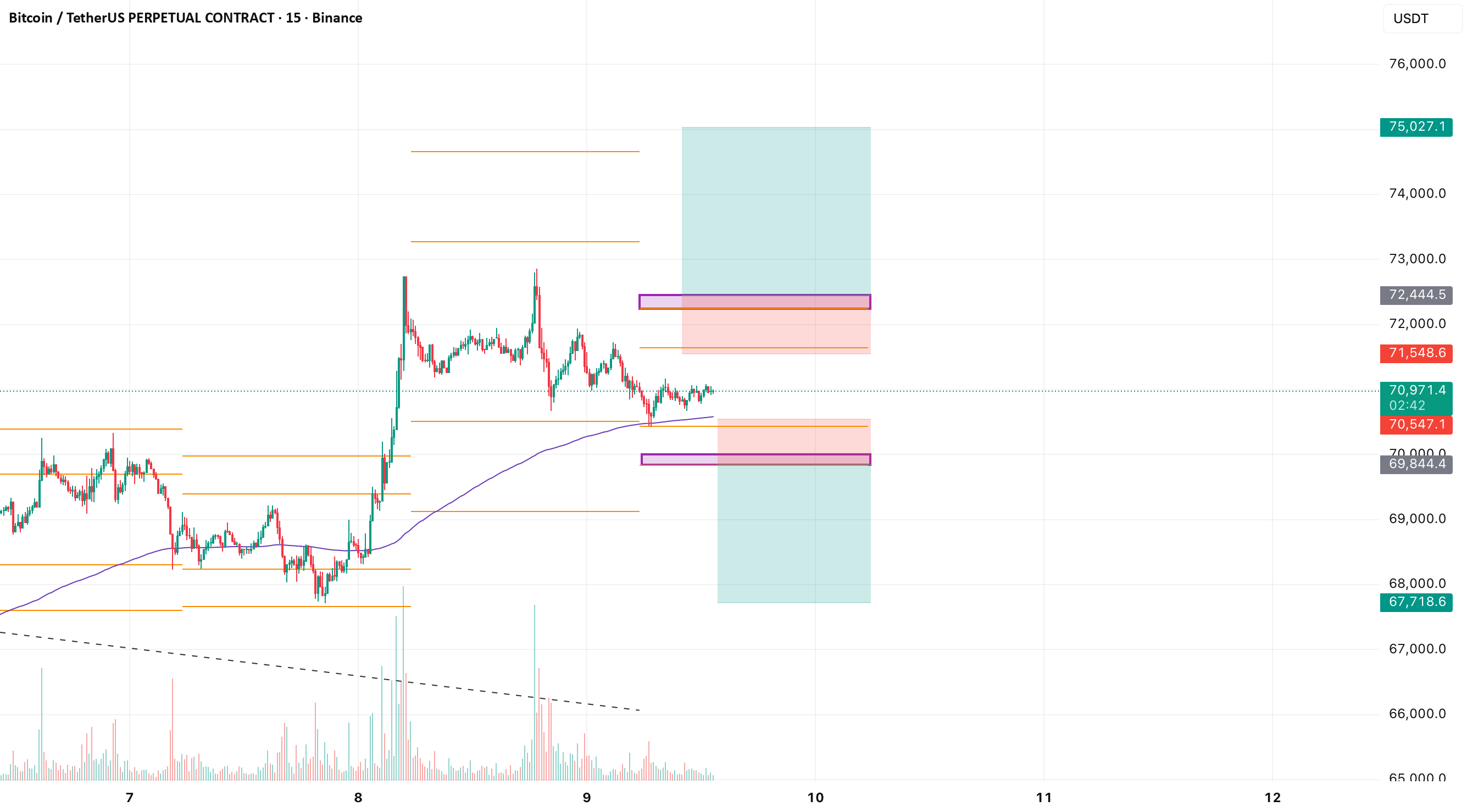
Hello to fellow traders, Right now BTC is trading at around 71k, as you can see in the chart, we might trade on either side BUY ABOVE 72200 and SHORT BELOW 68800. The price is showing a downward momentum as we can witness heavy call writing at 72k and 74k.Upside is capped for now Price is consolidating in between Right now. As for the short Trade, that was given yesterday in the ideas, one can place SL to BE and let it ride till the TP. As inflation rate and weekly expiry both tommorrow, we can expect some volatility. For more Clarity refer to the chart For more BTC OI updates do follow