koreajoongangdaily_joins40d ago
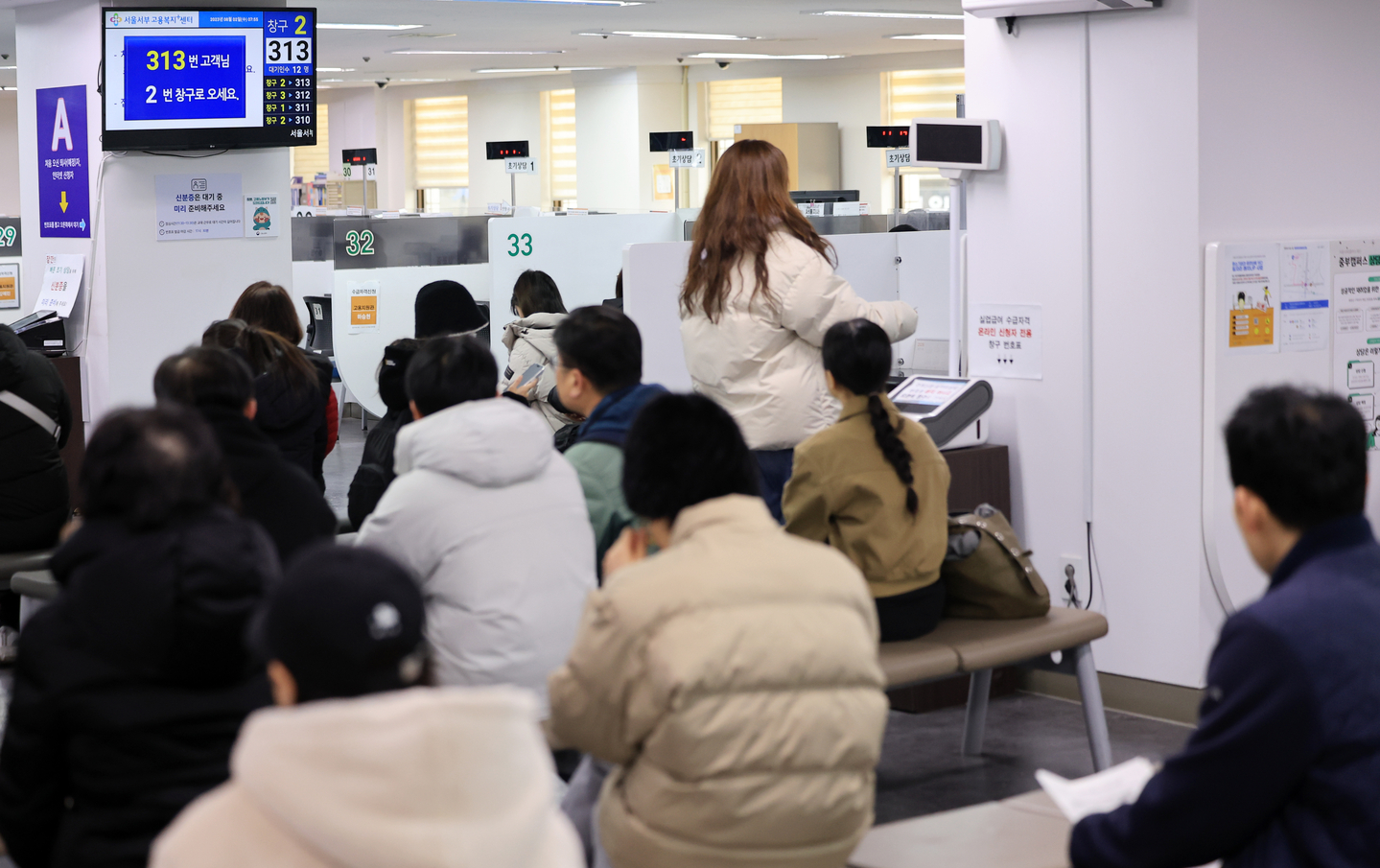
People wait at the Seoul West Employment and Welfare Plus Center in Mapo District, western Seoul, on the same day. [NEWS1] Stock markets are booming and exports continue to set monthly records. Yet beneath the economic momentum, one key indicator is moving in the opposite direction: youth employment. According to data released by the Ministry of Data and Statistics on Tuesday, the number of jobs held by workers in their 20s and younger fell by 127,000 in the third quarter of last year compared with the same period a year earlier. This contrasts with an overall increase of 139,000 jobs across the economy. Youth employment has declined for 12 consecutive quarters. Other indicators point to the same trend. While the overall employment rate for those aged 15 and older reached a record 61 percent in January, the rate for young people aged 15 to 29 stood at just 43.6 percent, the lowest level since 2021, when the economy was still affected by the Covid-19 shock. Job losses among young workers are also outpacing demographic decline. The population in their 20s fell 3.5 percent from a year earlier, but the number of wage earners in that age group dropped 5.5 percent. The decline was even sharper for regular positions, often considered more stable employment, which fell 7.9 percent. At this point, the deterioration in youth employment appears more structural than cyclical. Companies have steadily moved away from large-scale open recruitment toward rolling hiring and experienced workers. This shift reflects rising labor costs within a rigid employment system as well as a widening gap between industrial demand and the skills produced by the education system. Related ArticleKorea adds 108,000 jobs in January, smallest growth in 13 monthsKorea Inc. pledges 270 trillion won as Lee calls for youth hiring, regional investmentOlder adults drive up employment rate as youth languish in job marketYouth employment in Korea declines for 19th month as joblessness rises among 30-somethings The rapid spread of AI is adding further pressure, with early-career and entry-level positions particularly vulnerable to automation. As job prospects weaken, the number of young people classified as neither working nor seeking employment has exceeded 700,000. Some observers warn of the emergence of a Korean version of a “lost generation.” If the problem is structural, the response must be structural as well. Calling in major business leaders and urging them to expand hiring is unlikely to produce lasting results. More fundamental policy changes may be needed to improve labor market flexibility and reduce regulatory burdens that discourage job creation. President Lee Jae Myung has acknowledged the dilemma, saying that while job security is important, improving overall job quality also requires alternative approaches that increase labor flexibility. The key issue is already well understood. What matters now is the speed of policy response. Even as the broader economy shows signs of strength, employment opportunities for young people continue to disappear. This article was originally written in Korean and translated by a bilingual reporter with the help of generative AI tools. It was then edited by a native English-speaking editor. All AI-assisted translations are reviewed and refined by our newsroom.